| Course | |||||
|---|---|---|---|---|---|
 | ... / Introduction to TalentLMS (001)ALL / LMS Welcome to TalentLMS! Using new software can be more frustrating than starting a show in the middle of the season. Watch this 15-minute video course to get familiar with TalentLMS and get the most out of your shiny new account. | ||||
 | Rizon The purpose of this training course is to equip Rizon Technical Representatives and Sales personnel with a strong foundation in refining knowledge. Our goal is straightforward: to build the most knowledgeable and effective field and sales force... | ||||
 | Rizon This module explores the measurable physical and chemical properties that define crude oil behavior in refinery systems. From API gravity to salt content, each parameter offers insight into how a crude will perform across separation, conversion,... | ||||
| Rizon This module provides a clear, refinery-walkthrough overview of the major petroleum refining processes. The objective is to help you “follow the barrel” from crude receiving through distillation, conversion, treating, and supporting systems,... | ||||
 | Rizon Distillation is the foundational separation process in petroleum refining. It divides crude oil into fractions based on boiling point, creating the feedstock required for all downstream conversion and finishing units. Before distillation, crude... | ||||
| Rizon Module Five builds on the separation fundamentals introduced in Module Four by examining how refineries extend separation beyond primary distillation. While atmospheric and vacuum distillation establish the basic structure of refinery separation,... | ||||
| Rizon After distillation, deasphalting, and dewaxing, refineries recovered most available fractions. However, gasoline and kerosene production still lagged rising demand driven by early automobile growth. | ||||
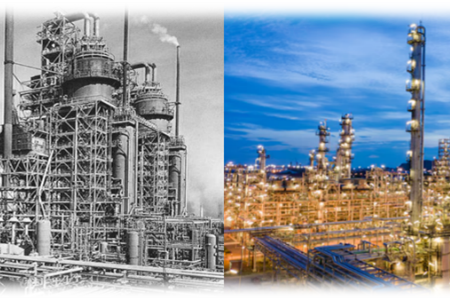 | Rizon Picture 7.1. Old and New FCCU The world's first commercial Fluid Catalytic Cracking Unit (FCCU) was commissioned in 1942 at Standard Oil of New Jersey's Baton Rouge refinery. During the early 20th century, refineries relied primarily on... | ||||
| Rizon | ||||
| Rizon Let us spend some time talking about what microbiological growth can do in a refinery and how it causes corrosion. |